Professor Saraswati Raju (1946-2026): A Pioneer Who Challenged Disciplinary Boundaries and Championed Gender in Geography
- Tanusree Paul

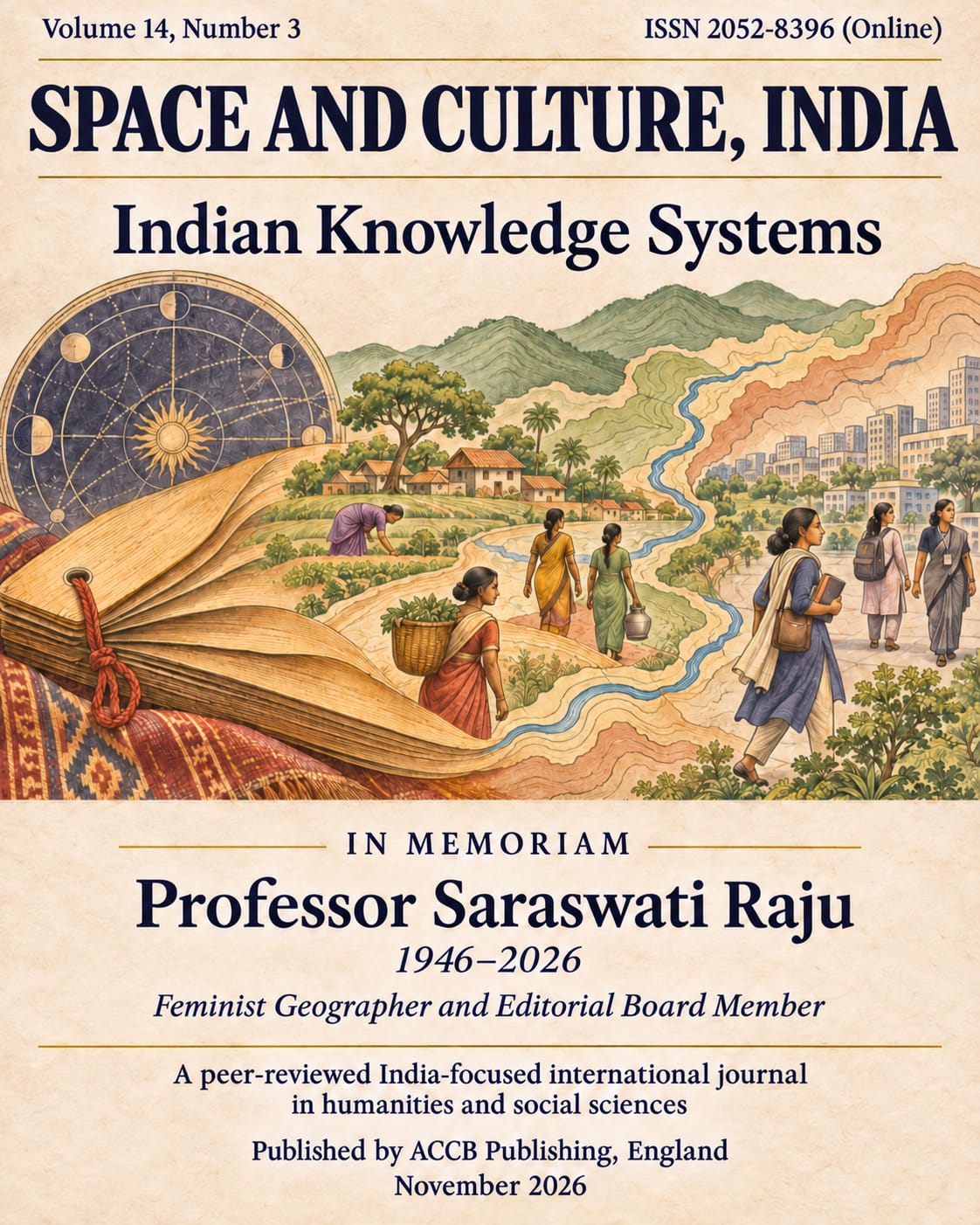
Abstract
Professor Saraswati Raju, the Social Geographer who worked at the Centre for the Study of Regional Development, Jawaharlal Nehru University, New Delhi, was a trailblazer who had many pioneering achievements to her credit. Her intellectual contributions positioned her as a vanguard figure who was a fierce advocate of critical approaches to geographical scholarship. She played a pioneering role in shaping and developing the sub-field of gender geography in India and made the voices of women from the Global South heard in the global academic discourses. She was also the first non-Anglo-American scholar to be honoured with multiple prestigious awards by the Anglo-American academic community in recognition of her exceptional scholarly achievements. Professor Raju breathed her last on 10th November 2026. This article is a tribute to her professional journey, focusing on her publications, distinctions and enduring legacy.
Keywords
Professor Saraswati Raju, Gender Geography, Social Geography, Critical Geography, India
Author Biography
Tanusree Paul
Dr Tanusree Paul completed her PhD in Social and Cultural Geography from the Centre for the Study of Regional Development, School of Social Sciences, Jawaharlal Nehru University, New Delhi. Dr Paul’s research engages with the relationship between gender and space, particularly in urban contexts, carefully documenting how women negotiate public spaces in cities such as Kolkata, examining fear, mobility, surveillance and the social production of safety. Dr Paul has also worked extensively on gender and empowerment in relation to domestic violence, health, and development policy, including areas such as water governance and development communication. Her scholarship has appeared in reputed journals such as Economic and Political Weekly, Gender, Technology and Development, and the Journal of Asian and African Studies, to name a few, as well as in edited volumes published by Routledge, Springer, Cambridge University Press, the Institute of Advanced Studies, Shimla and so forth.
References
- (2016). (edited) Women workers in urban India. Cambridge University Press. (with S. Jatrana)
- (Sept. 2011). (edited) Gendered Geographies: Space and Place in South Asia, New Delhi: Oxford University Press.
- (Jan. 2011). (edited with Kuntala Lahiri-Dutt) Doing Gender, Doing Geography: Emerging Research in India. New Delhi, London: Routledge
- (Dec. 2006). (edited with Alikhan F. Kyei P. Mawdsley E., Porter G. and Townsend J), NGOs and the State in the Twenty-First Century: Ghana and India. Oxford: INTRAC
- (Feb. 2006). (edited with M. Satish and S. Corbridge) Colonial and Post-Colonial Geographies of India, New Delhi: Sage.
- (April 2000). (with Ann Leonard) Men as Supportive Partners in Reproductive Health: Moving from Rhetoric to Reality, New Delhi/New York: Population Council.
- (April 1999). (with N. Kumar, Janet Townsend and Peter Atkins) Atlas on Women and Men in India, Kali for Women, New Delhi, India
- (Dec. 1994). (edited with Deipica Bagchi) Women and Work in South Asia: Regional Patterns and Perspective. Routledge: London and New York.
- (2014). Gendered labour in India: Diversified or confined?. Economic and Political Weekly, 197-208. (with Tanusree Paul)
- (2013). ‘Women in India’s New Generation Jobs’, Economic and Political Weekly, 48 (36):16-18.
- (2013). ‘The Material and the Symbolic: The Intersectionalities of Home-Based Work in India’, Economic and Political Weekly, 48 (1): 60-68.
- (2011). ‘Child Sex Ratios in India: The Emerging Pattern’. Yojana 55, 21-27.
- (2009). ‘Contesting postmodernism: A view with a gendered lens’ Eastern Geographer 15: 23-30
- (2009). (with Arpita Banerjee) ‘Gendered mobility: Women migrants and work in Urban India’, Economic & Political Weekly, 54 (28): 115-123.
- ----- (with M. John, R. Kaur and R. Palriwala) ‘Dispensing with daughters: Technology, society, economy in north India’, Economic and Political Weekly’, 44 (15): 16-19.
- (2008). ‘Editorial’, Social Change 37(4): i-iv
- (2008). ‘Sticky floors, high ceilings: Skilled and ‘gendered’ workforce –leanings from Chennai and Delhi firms’, Social Change, 37(4): 91-109
- (2008). (with Harihar Sahoo) ‘Domestic violence in India: Evidences and implications for working women’, Social Change, 37(4): 131- 152
- (2007). (with Md. Sanjeer Alam) ‘Contextualising Inter-, Intra-religious and Gendered Literacy and Educational Disparities in Rural Bihar’, Economic and Political Weekly, 40 (2): 137-47.
- (2007). ‘Contextualizing gendered discourses: Training, skills and urban labour market’ in J.B.G. Tilak (ed.), Women’s Education and Development, New Delhi: Gyan.
- (Dec. 2007 published in Jan. 2008) Guest- Editor, Social Change, 37 (4)
- (2006). (with Sucharita Sen) ‘Globalisation and Expanding Markets for Cut-Flowers: Who Benefits?’ Economic and Political Weekly’ 41 (26): 808-810.
- (2006). ‘Contextualising Gender Empowerment at the Grassroots: A Tale of Two Policy Initiatives’, GeoJournal, 65(4): 287-300.
- (2006). ‘Production of Knowledge: Looking for ‘Theory’ in ‘Familiar’ Places?, Invited guest editorial, GeoForum, 37 (2): 155-161.
- (2005). ‘Limited Options - Rethinking Women's Empowerment ‘Projects’ in Development Discourses: A Case From Rural India’, Gender Technology and Development, 9: 253-271.
- (2004). ‘Contextualizing Critical Geography in India: Emerging Research and Praxis’, Geoforum, UK
- (2004). ‘Teaching and Researching the Geography of Gender: A Journey of Negotiations and Contestation’, Geography and Gender Reconsidered, Women and Geography Study Group of the Royal Geographical Society, Institute of British Geographers. Edited by Joanne Sharp, Kath Browne and Deborah Thien, and published on a CD-ROM, pp. 64-67.
- (2003). (with Nagar) ‘Women, NGOs and the Contradictions of Empowerment and Disempowerment: A Conversation’, Antipode 35 (1): 1-12.
- (2002). ‘We are Different, but Can We Talk’, Gender, Place and Culture, 9(2):173-177
- (2001). ‘Negotiating with patriarchy: Addressing men in reproductive and child health’, Economic and Political Weekly, 36 (Dec. 8-14):4589-92.
- (1998). (with Premi) ‘Born to Die: Female Infanticide in Madhya Pradesh’, Search Bulletin, 13(3): 94-105.
- (1997). ‘Human Resource, Development, Gender and Labour Market Segmentation’, Pondy Papers in Social Sciences.
- (1997). ‘Capturing Complexity: A Critical Rethinking on Ecofeminism and Gender’, Journal of Social Sciences, 1 (3): 221-228.
- (1997). ‘The Issues at Stake: An Overview of Gender Concerns in Post Independence India’, Environment Planning, 29 (21): 91-2206
- (1997). (with Atkins, Naresh and Townsend), ‘A Geography of Sex Ratio’, Espace, Populations Societies, 2 (3): 161-171.
- (1997). (with Naresh Kumar, Atkins and Townsend), ‘Where Angels Fear to Tread? Mapping Women and Men in India’, Environment and Planning, 29 (2): 207-15.
- (1992). (with Premi) ‘Decline in sex ratio: Alternative explanation re-examined,’ Economic and Political Weekly, 27(17): 911-912.
- (1991). ‘Gender and Deprivation: A Theme Revisited with a Geographical Perspective’, Economic and Political Weekly, 26 (51): 2827-2839.
- (1991). ‘Gender and Caste Disparities in Literacy in Urban India’, Aarthik Samvad, 2 (1): 5-8.
- (1989). (with M. Satish) ‘Gender and Geography: An Overview from India’, Journal of Geography in Higher Education, 13 (1): 102-104.
- (1988). ‘Female Literacy in India: The Urban Dimension’, Economic and Political Weekly, 23 (44): WS57-WS61.
- (1987). ‘A Socio-Geographic Analysis of Female Participation in Labour Force in Urban India: Madhya Pradesh as an Example'. Asian Profile,
- (1982). ‘Regional Patterns of Female Participation in Labour Force of India’, The Professional Geographer, 34 (1): 42 - 49.
- (1980). ‘The social meaning of 'urban neighborhood' in India’, Ekistics; reviews on the problems and science of human settlements 47(283):286-9.
- (2017). Public Space and Place: 'New' Middle Class Women and the Gendered Interplay in Urban India, in Manjeet Bhatia (ed.) Locating Gender in the New Middle Class in India, pp. 99 – 128, Indian Institute of Advanced Studies, Shimla, India, [ISBN: 978-93-82396-44-4] (with Tanusree Paul)
- (2013). ‘Beyond the familiar: Women’s agency and empowerment revisited’, in A. Saxena (ed.) Marginality, Exclusion and Social Justice, Jaipur: Rawat Publications, pp. 30-48.
- (2011). ‘Introduction’ in S. Raju (ed.) Gendered Geographies: Space and Place in South Asia, New Delhi: Oxford University Press, pp. 1-30.
- (2011). ‘Reclaiming spaces and places: The making of gendered geography of India’ in S. Raju (ed.) Gendered Geographies: Space and Place in South Asia, New Delhi: Oxford University Press, pp. 31-59.
- (2011). (with K. Lahiri-Dutt) ‘Introduction’ in S. Raju and Lahiri-Dutt (eds.), Doing Gender Doing Geography: Emerging Research in India, New Delhi and Oxford, UK, pp. 1-11.
- (2011). (with K. Lahiri-Dutt) ‘Engendering the androcentric discipline of geography and claiming a place: Revisiting the (un)familiar’ in S. Raju and Lahiri-Dutt (eds.), Doing Gender Doing Geography: Emerging Research in India, New Delhi and Oxford, UK, pp. 12- 44.
- (2009). ‘Nongovernmental Organizations’ in Kitchin R, Thrift N (eds.), International Encyclopedia of Human Geography, Volume 7, pp. 450-455. Oxford: Elsevier.
- (2009). ‘Polyvocality’ in Kitchin R, Thrift N (eds.), International Encyclopedia of Human Geography, Volume 8, Oxford: Elsevier, pp. 265-268.
- (2009). ‘Agency, structure and women situated subject: Changing the terms of gendered discourse and exploring ways to crack the gendered codes’, in Das B. and V. Khawas (eds.), Gender Issues in Development Concerns for the 21st Century, Jaipur: Rawat Publications, pp. 7-19.
- (2008). ‘Gender differentials in access to higher education’ in Higher Education in India: Issues Related to Expansion, Inclusiveness, Quality and Finance, University Grants Commission, pp. 79-102
- (2007). ‘Contextualizing gendered discourses: Training, skills and urban labour market’ in J.B.G. Tilak (ed.), Women’s Education and Development, New Delhi: Gyan Publishing House, pp. 151-174.
- (2007). (With Isa Baud) ‘Life aspirations and embedded contexts: Gender and vocational training in segmented labour markets in Indian cities’ in Shah A. (ed.), Indian Cities in Transition, New Delhi: Orient-Longman, pp. 412-445.
- (2006). (with S. Corbridge and M. Satish) ‘introduction’ in S. Raju, M. Satish and S. Corbridge (eds.), Colonial and Post-Colonial Geographies of India, New Delhi: Sage, pp. 13-22.
- (2006). ‘Locating women in social development’ in A. Kundu (ed.), India: Social Development Report, New Delhi: Oxford University Press, pp. 77-95
- (2006). ‘From Global to Local: Gendered Discourse, Skills and Embedded labour Market in Urban India’ in S. Raju, M. Satish and S. Corbridge (eds.), Colonial and Post-Colonial Geographies of India, New Delhi: Sage, pp. 99-119.
- (2004). ‘Gender and Geography in India: Why the Two shall meet?’ in Swapna Guha-Banerjee (ed.) Spatiality of Society: Trends in Indian Human Geography in the 21st Century, Jaipur: Rawat Publishers, pp. pp. 83-101.
- (2004). “Foregrounding women missing gender: Policy intervention creates ‘Thus far and no further’ supportive influences- A Case from India,” in Lise Nelson and Joni Seagar (eds.), A Companion to Feminist Geography, Oxford: Blackwell, 2004. Feminist Reader, USA: Blackwell, pp. 194-207.
- (2004). Raju S and A. Datta ‘On Not Holding Half the Sky: Gender in Indian Geography’, in H.N Sharma (ed.) Progress in Indian Geography: A Country Report, 30th International Geographical Congress,Glasgow, Indian National Science Academy, 2004, Delhi. pp 131-134.
- (2001). ‘Sustainable Livelihood, Gender and Food Security in Rural India’ in M. D. Asthana and P. Medrano (eds.) Towards Hunger Free India: Agenda and Imperatives, New Delhi: World Food Programme, pp. 158-180.
- (2000). ‘Caste and Gender Interface in Workforce Structure’ in Caste and Economic Inequality: Untouchables Bear the Burden in S. K. Thorat (ed.) Manohar: New Delhi.
- (2000). ‘Country Situation -Module A (Physical Features, History and Political Structure, Social Features, Education, Environment)’ in National Profile on Women, Health and Development-Country Profile, India, New Delhi: Voluntary Health Association of India.
- (1997). ‘Making them Visible: Gender and Work in Indian Census’ in M. E. Khan (ed.) Work Health and Contraception: Women’s Perspective, New Delhi: Hindustan Publication, pp 39-58.
- (1996). ‘Gender Issues of Social Concern’, Progress in Indian Geography, New Delhi: Indian National Science Academy, pp 45-49.
- (1993). ‘Women and gender in Geography: An overview from South Asia, Introduction’ in Janet Momsen and V. Kinnaird (eds.) Different Places, Different Voices: Gender and Development in Africa, Asia and Latin America, London and New York: Routledge, pp. 77-79.
- (2007). Annihilating Spaces and Assertive Geographies in Globalizing India, Centre for the Study of Regional Development, School of Social Sciences, Jawaharlal Nehru University, New Delhi, pp. 1-30.
- (1984). Female participation in the urban labor force: A case study of Madhya Pradesh, India, Michigan State University, East Lansing, MI, USA, pp. 1-26.
- (1982). A Place for Everyone: Social Order and Residential Pattern in Urban India, No. 73, Department of Geography, Syracuse University, NY, USA, pp. 1-70.
- (1981). Sita in the City: A Socio-geographical Analysis of Female Employment in Urban India, No. 68, Department of Geography, Syracuse University, NY, USA, pp 1-67.
- Book Reviews:
- (2007). ‘Caste, Marriage and Inequality: Essays on North and South India’ by Pauline Kolenda. The Book Review, 31 (1): 12-13.
- (2006). ‘The Geography of Sustainable Development’ edited by Martin Purvis and Alan Grainger. TerraGreen, 3(1): 72-73.
- (2005). ‘Gender and Social Equity in Primary Education: Hierarchies of Access’ edited by Vimla Ramchandran, The Book Review, October.
- (2004). ‘Environment, Knowledge and Gender’ by Sarah Jewitt in Singapore Journal of Tropical Geography, 26 (2): pp. 67-68
- (2004). ‘Contemporary India: A Sociological View’ by Satish Deshpande in The Book Review, 28 (2): pp. 42-3.
- (2001). Susie Jacobs, Ruth Jacobson and Jen Marchbank (eds.) ‘States of Conflict: Gender, Violence and Resistance’, The Book Review 25 (2): 9-10.
- (2000). Carl B. Holmberg, ‘Sexualities and Popular Culture’ in The Book Review.
- (1995). Susanne Thorbek ‘Gender and Slum Culture in Urban Asia’ The Book Review, 10 (4): 10-11
- (2010). Mapping the World of Women’s Work: Regional Patterns and Perspectives, ILO, New Delhi Office
- (2010). Gendered Access to Higher Education in Kerala, the State Higher Education Council, Thiruvanthapuram, Kerala
- (2008). (with M. John, R. Kaur and R. Palriwala) Planning Families, Planning Gender: the Adverse Child Sex-ratios in Selected Districts of Madhya Pradesh, Rajasthan, Himachal Pradesh, Haryana and Punjab, Actionaid and IDRC, New Delhi
- (2004). Contribution on the Indian Scenario to the Thematic Review Report on Vocational Training Education, ILO, New Delhi Office
- (2004). Contribution on the Indian Scenario to the Thematic Review Report on Formal and Non-Formal Education, ILO, New Delhi Office
- (2003). Social assessment: access to RCH services by vulnerable population: A Qualitative Study at Gurgaon District, Haryana, Sponsored by DFID and Ministry of Health and Family Welfare, India, pp. 1-72
- (2001). Gender Impact Assessment of Haryana Integrated Women’s Empowerment and Development Project, Unpublished